Heather and I were married 40 years ago in the little white church along the Broad Brook, right in the center of East Barnard, Vt.
Nearly everyone in the village attended our wedding that day. The store, next door to the church, and the only business in the village, closed for the day and put a sign on the door that said, “Closed for Randy and Heather’s wedding, you come too.”
East Barnard was, and still is, a small community; our neighbors are all friends or relatives, many both. Heather and I grew up at opposite ends of the little village and played together as children. My family, the Leavitts, settled along the Broad Brook in the late 1700s.
Heather’s grandfather bought a farm down the brook from the village in 1938. We live on that farm now.
The wedding was a joyful day. As we joined hands and said our vows, officiated by both Heather’s grandfather and mine, we were the first couple to join our respective families together in all the years both families lived along the brook. The little church was standing-room-only. It seemed like everyone in the valley was there… except Heather’s brother Clive.
He was sailing to Alaska aboard a three-masted Barkentine schooner.
Clive was a tall-ship sailor. That’s the first thing I say to anyone interested, but unfamiliar with him, or his life. Those few words seem to set the stage for anything else I might say.
When he went to sea after high school on an old wooden sailboat, it seemed he couldn’t have found a better place, and fit, for himself. Although he sailed on different vessels, at the time of our wedding he was on the Regina Maris, Queen of the Sea, a 140-foot, three-masted barque, built in Denmark in 1908, ported in San Diego, Calif.
The Regina Maris was contracted to sail along the pacific coast from the Galapagos to Alaska carrying teams of oceanographic scientists studying humpback-whale migration patterns. Clive was the first mate on the Maris. He knew ropes and knots and how to work canvas into a sail. He learned smith-work and could forge and build with iron and steel. He was drawn to all these hard, gritty, fascinating, soulful things from older times, but tall-ships were tall-ships, and Clive loved them.
Along with being a seafarer, he was a storyteller, a singer, a guitar player, and he could make you laugh. We missed him at the wedding.
A few months after our wedding, Clive returned home to Vermont for Christmas. It was great having him around again between his sailing adventures. Then, late one night, in early January, driving home from town, he wrapped his car around a tree. He didn’t survive. He was 25.
•
There is no extra space on board a tall ship. You get a bunk, and a tiny space for your kit, that’s it. Being a man of few possessions, Clive was comfortable with that. He could fit everything he owned, most of which came from a thrift shop, into a backpack … except his guitar. The guitar was slung over his shoulder, stuffed into a sailcloth bag made by a friend at the Friday Harbor Sail Company. We don’t know just when or where Clive got his guitar, or from whom, but once it showed up in his hands, it was ever present. He would make up a song for you right on the spot, with rhyming, coherent lyrics drawn from anything that came to mind: your name, the color of your shirt, what you were eating, or the fact you were laughing at his previous verse. Everything was fodder for the current verse and his guitar was the music behind it all.
When Clive died that heartbreaking night in January, aside from his kit and a cruise journal written during his last voyage, his guitar was the only physical object he left behind.
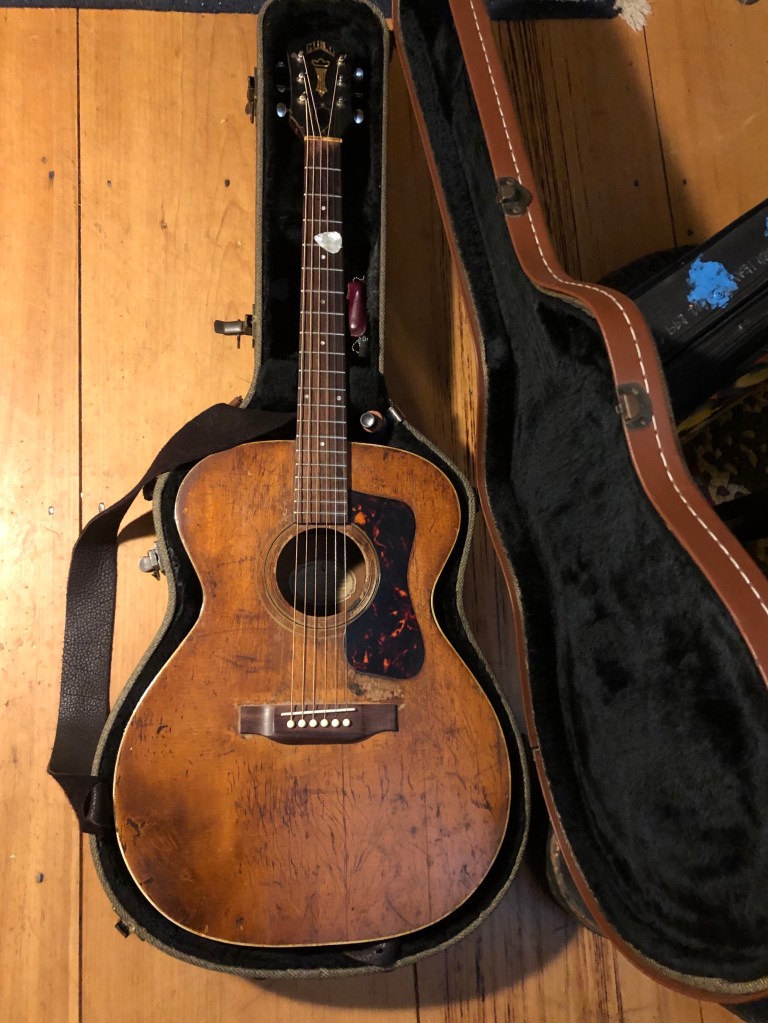
The guitar, a 1965 Guild F-30, grew in importance to us over the years of missing Clive. Back in the early days after his death, we gave the guitar to George, one of Clive’s good friends, a guitar player and oftentimes housemate who never lived far from the docks along the Northeast coast. We thought it was a good place for Clive’s guitar, in the hands of one of his friends. No one in the family needed the guitar, it was kind of beat-up what with all those hard years of shipboard life, and most significantly, we were so devastated by Clive’s departure that making a gift of his favored possession to one of his dear friends was something we actually could do, in a time that felt like there was nothing we could do.
It made us feel better to help someone else feel better.
Heather and I went back to college later that January. Time passed, and, years later, we built our own home on the farm and started a family. Our two boys, Asa and Simon, grew up there, the eighth generation in the Broad Brook valley. Our friend George kept the guitar for quite a few years, but eventually brought it back to us when he heard Asa, by then in his mid-teens, was interested in learning to play guitar. George told us when he delivered it to us that he had just been keeping it safe for us, until we needed it back. By then, we were very glad to have Clive’s guitar back with us.
Asa used the guitar for a few years, but eventually his teacher convinced him it was in such rough shape that it was very difficult to play, that it would inhibit his further learning and, he feared the guitar might actually fall apart. It was heavily worn, with lots and lots of obvious cracks on the top and sides, you could hear the internal braces rattle if you gave it a good shake, and worse, the neck had moved out of alignment. Not long after learning all this we bought Asa a new guitar for his high school graduation and Clive’s guitar came back to our house again, this time, cherished more than ever, beautiful in it’s way, what with its salty patina, but by now, basically unplayable.
We moved it around the house over the next 20 years. For a while it hung from a hook on the living room wall, until we repainted. Then it took up residence in a hallway corner, then a closet. One time, for Heather’s birthday a friend carefully tuned it up to a low pitch and played a song … but it seemed risky to leave it with any tension on the strings so we let the strings go slack and it went back to its corner.
Really, just having it in our house was enough.
Then, last spring, nearly 40 years after Clive died, during a spring cleaning episode, I convinced myself I should try to get the guitar fixed or at least find out if that was even possible. I didn’t mention it to Heather. I didn’t think she would notice it was gone and if it was fixable I thought it might be a nice surprise.
I called a new acquaintance, Jake Wildwood, a local, luthier legend, who calls himself “The Country Guitar Doctor.” I made an appointment with the Doc and eventually drove the guitar to his workshop. He works in the back of an old country store, now an antique shop, owned by his family. It doesn’t look like a guitar shop … until you go out back.
Jake agreed the Guild was in terrible shape … nearly destroyed is what he said. But he also said it was fixable and might be a good sounding guitar. He agreed to have a go at it. I told him there was no hurry…it had been unplayable for 40 years, I said he could just take his time.
But, I thought about it all summer, and by August, I called him again.
I told him more about Clive’s story and the approaching 40-year mark of his sad departure. I asked if it might be possible to get the guitar restored by Christmas. He agreed.
•
With no word by mid-December I had given up on the guitar as a surprise under the tree. I knew Jake was very busy, and I had originally told him timing was not an issue. I was prepared to honor that, and wait. But then I got a call—Heather happened to be in the same room.
Jake told me the repairs took more work than he expected, but the Guild was ready. Forty years after Clive brought himself, and his guitar, home from the sea for the last time, the guitar was ready to be played again. And, Jake told me, “it sounded fantastic.”
With Jake’s enthusiasm on the phone, I quickly dismissed any notion of sneaking off to get the guitar as a Christmas surprise for Heather.
By the time I hung up, I knew she needed to come with me to meet Jake in person, to see his shop and hear about the work he did on her brother’s guitar. And, I wanted Jake to play a tune for Heather. So when she asked me who was on the phone, I told her we were off on an adventure, no questions allowed, and that she should just breathe whenever she felt overly curious.
She went along with this riddle until an hour later when we pulled up to the old country store, now called The Wildwood Flower. We walked onto the porch, along the rail where horses would have tied up back in an earlier time. At the door, I turned to Heather and asked if she had any idea why we were here.
“No,” she said, “you’ve got me. I have no idea.” I laughed, turned the knob and pushed open the door. Jake was just inside the door, sitting behind a low counter.
“Hi Jake,” I said, “this is my wife Heather. She has no idea why we’re here.”
Jake says, “Oh, hi Heather,” reached off to his left, came up with the guitar, which was all tuned and leaning against the counter, waiting for this moment.
“This is why you’re here” he said. He began to play. The years melted away.
As Jake played, he talked about the work he did and how much he liked the feel and the sound. To get the guitar back into playing shape Jake removed and reset the neck, dressed the frets, glued and cleated many small cracks on the top and the sides, replaced, or reglued, much of the interior bracing, replaced the saddle and the bone nut at the top of the fretboard. He cleaned it inside and out, got rid of the dust and grime, but left the patina just as it had developed over time at sea and then, that very day, strung it up. It was a lot of work, but it looked happy, and it sounded great. We brought it home. As there was no reliable, hard case to protect the Guild, I stopped by Hanover Strings, our local guitar store across the river, without the guitar, and purchased a simple, black case that the sales guys felt would, most likely, fit an F-30. When I got home and tried it I found the case was too big for the Guild, so I returned to the store a few days later. This time I brought the Guild with me, protected, but slipping around a bit inside the shiny new case.
The sales guys had heard some of my story about the guitar a few days earlier when I purchased the case; they were all anxious to see it. While they were looking it over and debating the proper case size, one of the guys came from out back.
“Look what I found,” he said and presented a vintage, 1965, Guild F-30 guitar case. I was astonished and thrilled. Clive’s guitar just floated, gently, down into the fluffy interior of that old case … just like it was made for it. Home at last.
That perfect, old Guild case has a small, metal, shield-shaped, logo-emblem mounted on it that says, “Guild, Made to be Played.”
As it turns out, and a surprise to me, I am playing it.
When it occurred to me last spring to call Jake to see if it was possible to repair the guitar, I was thinking mostly of making the beautiful aesthetic of this family heirloom and its importance to our lives even more present by making it a functional instrument again. I thought that it would return to its corners around the house, as before, and that I might play it once in a while.
At that moment, I considered myself a fiddler, not a guitar picker. Oh, I had a guitar once, a long time ago, an uninspiring 12-string I played with only six strings, which I thought might make it easier. I did some self-taught, elementary guitar work, slowly teaching my fingers to make basic chords. I even strummed along and sang songs with Clive back when he was in town between adventures, but I was too busy with other things then and never found the enthusiasm to keep after it, and so didn’t develop any real skills or repertoire. But now, the reality is I have opened that case, and played Clive’s guitar, every-single-day since it came home to us last Christmas, often for hours at a time.
The Guild F-30 has its own storied history. Mississippi John Hurt played one, as did Paul Simon when he and Art Garfunkle recorded “Bridge Over Troubled Water.” It turns out the F-30, up until the late ‘60s when the factory made some design changes to the guitar that significantly changed the sound, was a highly regarded guitar for folk music, acoustic blues, and the like. This particular F-30 has all that behind it, and its own unique history, such as I have recounted here.
They may all have a certain tendency to be great guitars, but for me, playing Clive’s guitar produces such rich, shimmering overtones that I find myself looking around sometimes, or stopping short in the middle of a song to see where that extra sound is coming from. I have often thought I heard someone else singing along behind me while I am playing. It has enchanted me.
•
I played a tune for Clive, on his own guitar, on January 10, 40 years after the tragic night he sailed away from us forever, and I think about him, his life, and our friendship, every time I play.
 The Traveling Front Porch
O. M. G. Randy, this is so heartbreakingly beautiful, such a humble, intimate distillation of the rare gold that is you and your family and your corner of Paradise. I recall you or Heather or both talking about Clive once or twice. That his guitar should find new life in your hands is like a kind of Tarot or mandala image of your whole friggin’ biography, Randy. You are THE most impossible and inevitable person I ever met.
As you tied your biography and Clive’s together in this precious tale, I kept thinking of that Samuel Eliot Morison piece you so loved to recite. My birthday (HA! 16 years on now from the one in the pink house, followed by the contra dance in the woolen mill across the Ottauqueechee. . . first image that leaps to mind was you with the upright bass in my shower. . . ) is coming up in March; might I selfishly request that you make a recording of it? I can supply the “Leave Her Johnny” melody to follow.
Love,
Dr. Dann
LikeLike
I might use these kind and generous words to help sell my book.
LikeLike