Preface
When a friend of mine injured himself in a work accident many years ago, I remember suggesting to him that during his convalescence he might take advantage of the down-time to learn, or do, something new and bold that he wouldn’t normally do. I figured, if you are forced to change from your normal path, you might as well make that new, unplanned, direction as fruitful and enjoyable as possible. “Take the time to learn Spanish or take a watercolor class,” I said to him. I know, I know, it’s easy to say such things when you’re not the one forced to make the unfortunate detour, but there it was…I said it.
The Old Reliable Horse Drawn Spectacular
I got a call from a fellow I had never met, who said someone had told him I was the person to talk to about music venues in this area. He went on to describe his project, The Old Reliable Horse Drawn Spectacular, a traveling band of musician-poet-artists-activists. They were planning a trip from northern Vermont to central Massachusetts in late summer, entertaining and educating people along the way with puppetry and song. He told me of their need for performance venues and simple lodging along the way. It all sounded great to me. I remember suggesting several places nearby that I thought might work for them; the new bandstand on the green in town, the Academy building that has a nice little stage and a kitchen, perhaps the high school if they needed a larger space. Then, while chatting with him, it dawned on me, and I said, “We have a dance hall in our barn.”
We really do. We stopped the dairy operation in 1988 after fifty years of cows. The century-old barn, mostly unused since the cows departed, had slowly filled with junk and needed some care. At some point our family decided we should rescue it before it was too late, and we did. We cleared the worst of the accumulated junk, organized most of the remaining collection of random lumber, tools and marginally useful items and changed the space into a family gathering place. The old milkroom was turned into a simple kitchen; we sandblasted the layers of cowmanasty and whitewash from the old ceiling where the calves lived, put down a wooden floor, installed new windows and sheetrocked the walls. The old sawdust room was cleaned out, opened up to the fresh air and turned into a cozy bar overlooking a new brick patio where the corn silos once stood. It was a monumental family effort that took several years. We had only just finished the last of the work when I got this phone call. The refreshed barn was so new to me that it took a moment, while talking, to realize it would be the perfect place for The Old Reliable Horse Drawn Spectacular.
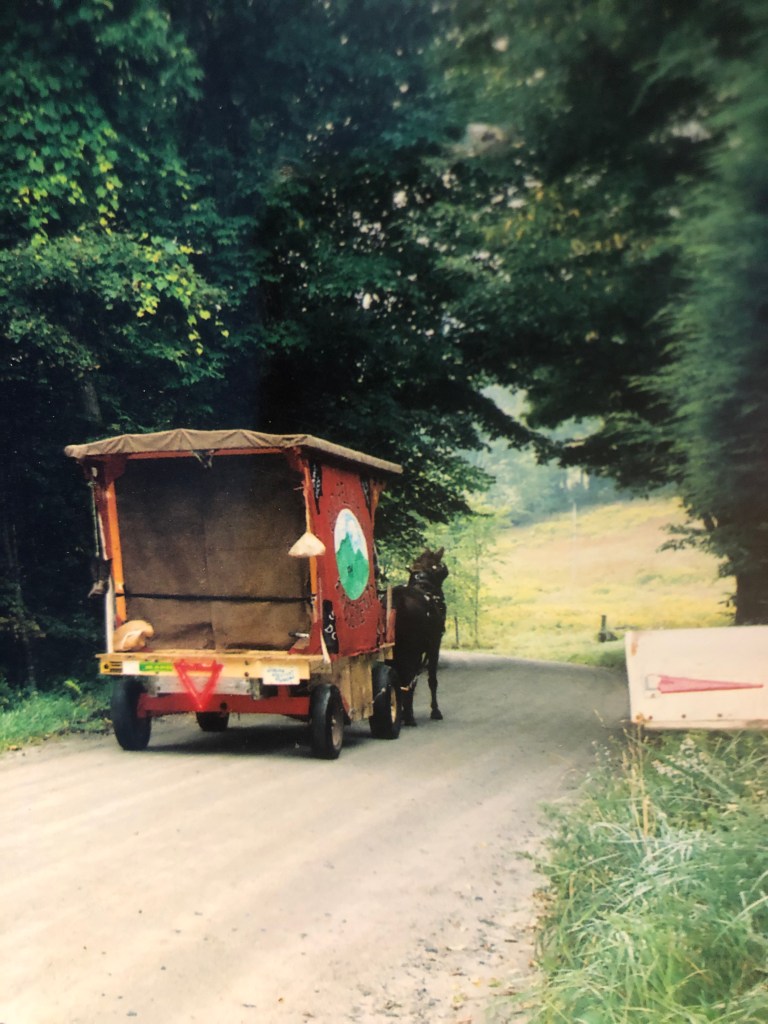
A few weeks later the troupe arrived, riding bicycles up the road to the farm, followed by a spry pair of Morgan horses hauling a covered wagon. The wagon was filled with props and gear and lots of instruments. It was all very exciting, like the circus had come to town. After all the initial greetings, the wagoner unhitched the sweaty horses, gave them a good hosing down and set them loose in the lower pasture to graze while the rest of the troupe set up camp behind the barn.
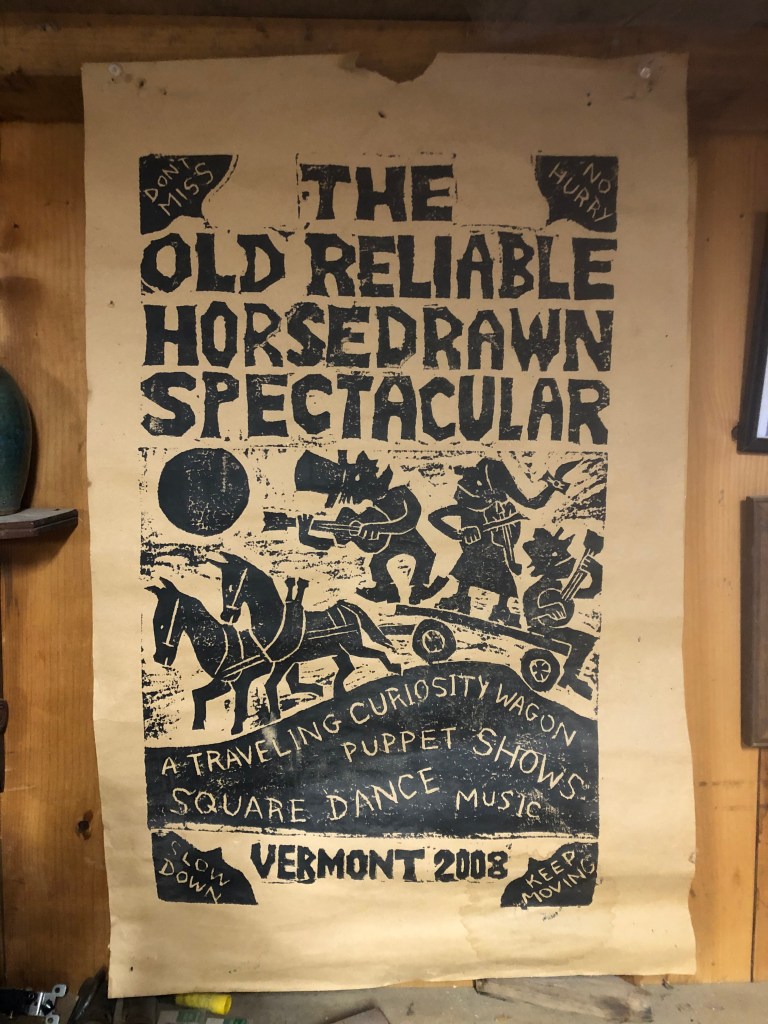
Over that weekend we sat in the deep green grass behind the barn, sharing stories, ate a ton of sweet corn fresh from the garden, roasted over a slow wood fire and drank most of my remaining hard cider from the previous year. We swam in the pond, made art and played countless tunes together in the shade. When Saturday night came, they presented the Spectacular to our family and friends in our new “Mead Hall.” The term taken from King Arthur’s time, meaning a protected place where it was safe to take off ones armor amongst friends; it’s where they kept The Round Table. The show in the Mead Hall was filled with stories, skits and songs, mostly humorous, some with a political edge, all excellent, enjoyable and well received by the small audience; then there was the cranky.
Earlier in the day one of the troupe members asked if I had something like an old broom handle that she could use for a project. I found something in the barn that fit that description and gave it to her. Nearly at the end of the show, and before the dancing began, she came out with a cranky, a small contraption with the broom handle functioning as a spindle with a crank handle attached to one end. Wrapped around the spindle was a roll of paper, like a scroll, all hidden behind some small doors that she swung open at the start of her performance. As she turned the crank, the story rolled by, detailed with her beautiful drawings and the song she sang to us about a small, lost bird, in love and filled with longing. I fell into her cranking story-song. It was mesmerizing, and I knew right then, I needed to make my own cranky one day. But I waited a long time.
Distal Phalanx
Until… once, at the end of a regular day, I sat on the edge of my bed to take off my socks. The first sock slid off well enough, but the second one bunched around my heel and stuck. I pushed harder with my fingers, and…Pop! The pain in my left ring finger was instant and sharp, like someone whipped it with a thin stick. The pain quickly diminished to a dull heat, but my dear finger was no longer working properly. I could fully open my hand, without any pain, but the fingertip, at the last knuckle, wouldn’t stand up. No mater what I did, it stayed bent over at a 90-degree angle. I showed it to my wife. “Here,” I said, “look at this,” holding my outstretched palm toward her with it’s folded finger. She made an ewey face and told me to stop it. I had to agree, it did look strange, like some sort of prank. I went to the kitchen, put some ice on it, and logged on to the Internet, one-handed, to look for advice.
I quickly found pages detailing my new ailment, Mallet Finger. Described as “an avulsion of the extensor tendon at the distal phalanx.” Which means the cable that runs from the forearm muscles, (where all your finger muscles live), continues through the wrist, across the length of the hand and up the finger, had pulled away from its lodging in the last bone. With no muscle-to-finger cable connection, there would be no hauling the finger to its extended position.
It turns out that an avulsion, when the tendon pulls free from the bone and has a little chip of bone still attached, is a far less traumatic injury than a broken tendon. Tendons heal very slowly, whereas bones, if attended to correctly, will knit together relatively fast.
The Internet further revealed that if the finger is held continuously, with a splint, in a hyperextended position, which slides the tendon, with it’s little bone chip end, back into its little bone home–for several months, it should heal well enough. I followed the online instructions, immobilized the joint with a nice homemade splint, continued the ice treatment to reduce swelling and went to visit the orthopedic doctor the next morning.
I was waiting for the doctor in an examining room, thinking about fiddling, my sorry predicament and feeling a little depressed when the doctor swept into the room and said brightly, “Hey Mr. Leavitt, what have you got?”
“Mallet Finger,” I replied, holding up my hand with the splinted ring finger pointed to the ceiling.
He said, “What?”
I said, “It’s an avulsion of the extensor tendon at the distal phalanx.”
He said, “I know what it is, let me see yours.” So I slid it out of the splint and showed it to him.
“Did you do it taking off your sock“ he asked casually, “Or folding a cardboard box, or putting on a fitted sheet?”
“Sock.” I said, dumfounded.
“Hmm, happens all the time,” he said,
He then explained about the distal phalanx (the last digit), its relationship to the tendons, leverage and how putting excessive strain on the end of the finger focuses all that force on the tiny tendon/bone connection. If something has to give, the weak point lets go. Apparently it’s a common injury. Rock climbers can have this trouble hanging from the edge of a cliff with their fingertips. So it seems, Mallet Finger is an injury of intrepid mountaineers, makers of beds and removers of socks. Be careful out there people.
Doctor Bright proceeded to make a fancier splint than the one I had conjured from a plastic milk carton, not as cool, but a good effort. As he finished up he left me with the understanding it would take two-three months in the splint and a few more months of physical therapy to get the finger back to normal. He also issued a warning that if I bent the finger, at all, before it was fully healed, the soft, freshly growing bone tissue would fail, separate again, and the hyperextended demobilization would need to start all over again, or the finger might not regain full mobility. I had seen some online photos of non-fully-recovered Mallet Fingers, so right then; this fiddler became dedicated to appropriate, careful and regimented self-care.
Later that day, when I got settled back at home, karma visited and reminded me about my very much earlier remarks to my friend…“making the new, unplanned, direction as fruitful and enjoyable as possible.” So, eventually, reluctantly, I began thinking about what I might do to, um… enjoy my little detour.
The Cranky
I first heard, The January Man, sung by Martin Carthy on New Hampshire Public Radio’s, “The Folk Show” while driving to Boston from Vermont. I attended the North Bennett Street School in the early-eighties to learn the art of traditional furniture making and so made the two-hour commute nearly every week for two years. This was also the time I began to carry a small cassette recorder with me everywhere. I would record songs directly off the radio, then listen and sing along with them a hundred times while working or driving. I went through a lot of AA batteries in those days. After I heard the first few stanzas of The January Man, I grabbed the cassette recorder and hit the red record button. Then I listened to it, over and over again, the rest of the way to Boston and beyond. It became part of my repertoire but I seldom sang it in those days.
When I decided to make a cranky and began looking for a cranky song, The January Man seemed like the best choice. I love the language, the poetry of the phrases; “September man is standing near, to saddle up and leave the year, and Autumn is his bridle.” Just beautiful. The song also has the right structure for a cranky; there is no chorus, and it is linear, like a roll of paper on a broom handle.
Although I am a maker of many things, I have never considered myself much of a painter, other than going after a house with a brush and a can of latex. So creating a 60-foot, continuous painting was intimidating. I wasn’t sure I could do it because I just didn’t know how, so it took a while to get started. Then I stopped, numerous times, feeling like it wasn’t going to be very good. But, after a while, the self-confident me won out over the self-doubting me and, eventually, I found myself pleasantly and fully engaged in the cranky, both as a piece of art, in itself, and with it’s long-term possibilities as a performance piece.
Because I am a woodworker, and I knew how to do this part, I made the cranky frame first. I used some second hand pine boards, made it tall enough for me to crank from a standing position with legs to support it’s own weight. I installed upper and lower spindles to hold the linear painting, each with a pulley on the end, the upper one with the crank handle, and a long, thin, leather drive belt connecting them. Once the frame was ready I went to the local thrift shop, bought all the white, flat sheets they had, cut them into strips and sewed them together endwise. To layout the song on the sheets, I divided the 60-foot strip into 13 sections, one for each stanza in the song. I also made a much smaller paper version of the cloth strip to develop the layout and begin translating the song into a flow of connected images.
I thought some about the meter of the song, the length of each segment and how everything related to the speed the crank, which I wanted to be turned leisurely. I lay as much of the sewn-up material on the floor as our house would allow, walked slowly along its length and sang the song to the cats racing around my feet. Eventually, satisfied with the basic layout and the rough images for each stanza, I got down to the actual painting, which was mostly done with colored markers and some old house paints.
I remember wanting to paint some ferns into the April section but I had to go outside, to find an actual fern, to see what they really looked like to be able to paint them. I couldn’t remember if the leaves were opposite or alternate off the main stem. it seemed like I should have known, but it was like that with a lot of things, and all very interesting, figuring out what I didn’t know, and then learning those things. Learning to see in a different way too, a better way I suppose, in order to transfer what was in my head onto the scroll.
I discovered I could make various stamps for repeated forms using potatoes. That was how the many footprints were made in the beginning of the song and also the flying birds in the September panels. The sailboat was a challenge but I was happy with how it came out in the end. Truly, I was happy with how everything came out in the end. It was a pretty good detour. Happily my finger healed back to completely normal. I learned how to properly remove a sock; a topic for another treatise, at another time. I shared the cranky so many times over the years, at so many venues, that I can’t remember them all, and always to an appreciative audience. I often find myself thinking now and then about the next one… the next cranky, not the next detour.
Epilogue
A lot of my music friends know these stories; The Mallet Finger, the Old Reliable Horse Drawn Spectacular, the Cranky and The January Man. Many of them were there through all of it, including the months with me moping around at jam sessions, not playing my fiddle at all, and then later, learning how to play, carefully, with my splinted ring finger pointed at the ceiling.
At some point, after these events were all in the past, I got a call from one of those music friends. She had received a call from an old friend of hers, who, among other things, told her he’d recently broken the end of his finger. He said to her, “You will never guess how it happened.”
She responded casually, “Taking your sock off?”
He said, “How in the hell did you know that?”
She replied, with no small amount of accumulated wisdom, “Oh, it happens all the time.”
 The Traveling Front Porch