Tortuguero, Costa Rica
My family and I lived on the Caribbean lowland side of Costa Rica, where the jungle meets the sea, working as co-directors of a research station run by the Caribbean Conservation Corporation, now known as the Sea Turtle Conservancy. The following story describes one of my experiences from that remarkable time.

With wet, black sand under foot, dense jungle crowding the open beach and a heavily overcast sky, the surrounding darkness is nearly complete. Thunderstorms out over the Caribbean provide an occasional flash, illuminate the fullness of the tropical sky to the horizon, and then plunge it back into darkness, leaving white branches, etched in my eyes. I pull my hat brim further down, blocking the lightning from my eyes to protect my night vision and slowly pick my way along the beach
As my eyes re-adjust, vague forms take shape at the corners of my vision; the line between the western sky and the tops of the trees, where black meets blacker; the gleam of the bioluminescence riding the waves, lighting its own way through the night to crash with its host on the sand and fade into the darkness; a drift log a few steps in front of me, half buried in the sand that blends back into the darkness as I attempt focus on it. As a creature of the daylight my eyes fail me in this opposite world. I move along the beach leaning forward into the night with a wide eyed stare, concentrating on my peripheral vision, looking at nothing, yet struggling to observe. Similar to holding your breath to hear the smallest of sounds, here I find I must avoid a direct focus to observe the faint objects around me, it’s a matter of not looking, in order to see, of trusting the corner of my eye.
I know this beach well from my daylight walks. I know the danger of its many logs and trees swept out of the nearby river mouth and stranded here on the sand, sometimes with dangerous, broken branches and roots still attached. I know of the powerful rip currents that force these trees onto the shore, shift enough sand to bury them and then leave the steep and changing sand berms scattered along the shore. So, tonight in the blackness I move slowly and with care.
Along this shore the breezes blow in off the sea by day, then at some point during the night, stop for a while, change direction, and blow back out to sea. The land, it seems, takes a deep breath, holds it, then lets it out. I stand here in the stillness of the pre-dawn, at the end of one of these daily exhalations, waiting for a new breath from the sea, fresh and nourishing. The air now is moist and warm, as if from the mouth of an animal, sticky and heavy, filled with the smell of flowers, earth and growing things, mold and rot, the smells of life and death in the rain forest.
I am walking a remote Costa Rican beach, 25 miles south of the Nicaraguan border near the village of Tortuguero, Spanish for “land of the turtle.” It’s late August, the height of the turtle nesting season and I am looking for Chelonia Mydas, the beautiful, Atlantic Green Turtle. The gentle, hard-shelled mother from the sea returning to lay eggs in her natal sand.
As the director of the Caribbean Conservation Corporation’s Biological Field Station in Tortuguero, I have walked this beach many times, found and watched green turtles nesting, either following others more experienced than myself, or later acted as a group leader. The nesting ritual of sea turtles is ancient and as magical as the sea itself. Tonight I wanted to experience it alone.
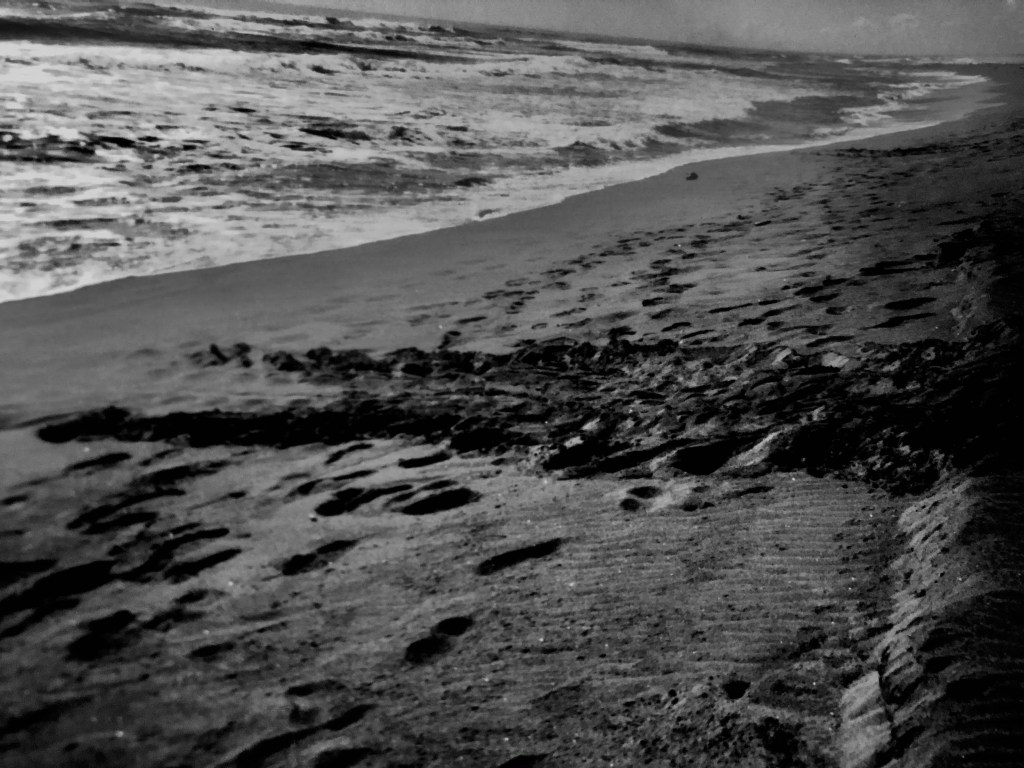
Walking up the beach, I see in front of me what appears to be another partially buried log. A few steps closer, it becomes recognizable as a broad band of darker sand, churned up as a turtle pushed its way from the waters edge to find a place to nest, well above the highest tides. When a turtle moves through the sand, her powerful front flippers push sand back behind her, making a track that is four to five feet wide, bordered on both sides with a series of angled ridges left from her front flippers, with a groove running down the center, the mark from her dragging tail. One can determine her direction by these ridges at the sides of the track. On nights with a partial moon or a little starlight, the direction of the turtle making the track is fairly easy to determine from a standing position. Tonight however, it requires a closer inspection, so I stoop to investigate. Feeling the sand ridges along the edge of the track I make this to be her inbound trail. I continue up the beach another few minutes to check if she has already finished laying her eggs and returned to the sea. I do find a second track, check its direction and verify that she has returned to the sea, so I continue on up the beach looking for another inbound track.
With streamlined shells and water wings instead of feet, these three hundred-fifty pound animals glide through the Caribbean for many hundreds of miles to this twenty-mile section of beach to mate in March and April. Females come ashore to nest in late May, and by August, the peak of the season, there can be thousands of them each night within this the largest green turtle rookery in the western hemisphere.
Green turtles are extremely cautious creatures, emerging only at night, to nest under the cover of darkness. With the buoyancy of water behind them, they must pull themselves over the sand with enormous effort, before finally choosing a nesting site as far as a hundred yards from the water, all the while wary of danger and quick to abandon the partially prepared nest and return home to the sea. It is for this reason that, even on this darkest of nights, I won’t use my small flashlight until I have located a turtle and she begins her final stages of nesting.
A short distance down the beach, I discover another inbound track. This time when I check for a return track, what I find is an inbound track. After finding no evidence that either or these turtles have returned to the sea I assume that there must be two turtles nesting nearby. With no idea how long either turtle has been at work, I follow the nearest track, inland towards the trees. I have to move even slower now in the darkness, looking for where the track ends, a dark disturbance in the sand with a turtle in the middle of it.
Once a turtle chooses a suitable nesting site, she begins to throw sand with her long front flippers, digging a pit perhaps twice the diameter of her body and one or two feet deep. Known as a body pit, this first stage of nesting is another one of the hazards of walking around in the darkness on this beach. The last thing I want do is fall into one of these craters and land on a turtle.
Moving further away from the crashing surf, I can hear the sound of sand being thrown into the underbrush at the edge of the encroaching jungle. Keeping low and walking softly, so as not to disturb her, I continue along until she comes into view. Crouching in an old body pit a few feet away, I watch her for a while and determine that she is just beginning her body pit. As digging her body pit can take as much as forty minutes, and what I enjoy watching most, is the next phase of nesting, I leave her and backtrack to the waters edge to see what the other turtle is up to.
I glance out to sea while walking back and notice a few stars peeking through gaps in the thinning clouds. With the improved visibility on the beach, I can just make out the first track a short distance down the beach, and head off towards it. The air, starting to move again, gives me the promise of some relief from the balmy heat and the sand flies that have been my constant companions. Once again I move away from the water to look for the turtle and find her lying at the bottom of her own body pit. She is resting, so I lie down in the sand behind her to wait, promptly get a face full of sand and so determine that she has not yet finished digging her pit. She however is much farther along on her pit than her sister and I expect she will soon be switching from throwing sand with her front flippers digging her body pit, to scooping out the egg chamber with her hind flippers. This is a completely different series of movements and is a wondrous thing to watch.
I watch the stars and wait nearby in another pit for her to make the shift. When she finally does, I move in to watch her hind flippers begin the difficult job of digging a two-foot deep hole in the sand below her. These flippers until now, functioning as rudders, steered her away from this shore, forty or more years ago. Now they have brought her here again, to begin a complex series of moves, never taught, always known, mother to daughter, from before the time of the dinosaurs. I watch each flipper as it takes its turn, slowly and carefully, dipping, scraping, gathering, lifting and then placing a small pile of sand behind her at the edge of the hole. The same flipper then takes a stance on its side of the hole to become a brace to support the turtle’s weight, while the other flipper readies itself for its descent into the slowly forming, vase-shaped chamber. What happens next is a move that punctuates the flipper’s change from one role to the other, from brace to shovel, from yin to yang, that comes with a surprising burst of speed. At the same moment that the shovel fin unloads and finds solid ground, the brace fin gives way, slashing at the sand piled at its side from its last scoop, sending it flying far up the side of the pit. Instantly following this dramatic and powerful movement, the flipper reverts to slow motion and begins its decent into the chamber with the care and gentleness of a mother preparing her nest. It is an ancient dance, every bit as mesmerizing as the licking flames of a wood fire or the twinkling of stars.
This phase of nesting lasts around ten minutes, perhaps longer if she runs into roots in the sand or other flotsam. Often a turtle will give up the nesting site if she can’t extend the chamber to the reach of her flippers, for that is when she knows that she is done. After a hundred or more of these cycles of, shovel-brace, shovel-brace, she stops, brings her flippers together over the hole like praying hands, breathes a great sigh and begins to fill the chamber with eggs.
Now concerned only with laying the eggs, she will be less disturbed by my presence. This is the time that our researchers would tag her and record the length of her carapace, or shell, and gather other biometric data. But I am not here tonight for science so I move in to a foot behind her and pull out my tiny flashlight to illuminate the chamber and watch the falling of over a hundred, white, leathery eggs, a bit larger than ping-pong balls. Out they come in short bursts of up to four or five eggs over the next ten minutes or so, until the hole is nearly full.
When she is done she rests for a moment and then begins to cover the eggs. First with her hind flippers until the chamber is even with the bottom of the pit. Then her front flippers start pushing more sand to her back flippers, to further disguise the nest. She will spend up to an hour working to camouflage the area. Impossible to remove all signs of her activity, she will, in this hour, make it hard to tell where in this large area of disturbed sand the clutch lays hidden.
These eggs will remain in the sand for sixty days when they will hatch, all at nearly the same time. The hatchlings don’t really climb out of the sand, as one might expect; it’s more of a group wiggle. At each wiggle, particles of sand trickle down below the cluster of turtles. In this way, the entire group slowly moves upward towards the surface, just as a pebble at the bottom of a bucket of sand floats to the top as the bucket is shaken. After three days of this movement, they begin to feel the heat of the surface sand, stop their upward movement and wait for cooler times. Emergence tends to occur in the early morning hours, just before sun up, or during a rainstorm when the surface sand temperature is safe. Then the two ounce hatchlings set out on their next adventure, an adventure that for just a few will bring them back here to Tortuguero, to this sand forty or fifty years from now.
I have seen enough for tonight, so as she continues to camouflage her nest I quietly take my leave, electing not to bother her sister turtle off to my right who is still thrashing amongst the sea grapes and morning glory vines. Moving away from her pit and standing to stretch, I feel the strength of the new breeze and greet a low crescent moon breaking through the clouds just above the trees. With the darkest part of the night chased away by the gathering moonlight, the crashing surf and much of the beach are now visible. A short way up the beach I can see the wet and shining shell a turtle breaking through the pounding surf on her way to nest.
I head home holding all the wonders of this night close in my heart; the pure darkness that surrounded me, the intermittent lightning, the mother turtles and their eggs below me in the sand even now beginning the transformation to baby turtles and the crescent moon breaking free to light my way home. Easily retracing the steps I struggled to make in the darkness only a few hours before, I see where my tracks weave between logs and piles of sea weed and then farther along where they cross the track of a sea turtle. As the sea mist condenses in my hair and the gathering drops begin to fall cool and fresh onto my neck and shoulders, I walk on to where the tracks cross, mine and hers.
 The Traveling Front Porch